Global Industry News
Showing posts with label CT. Show all posts

High-Slice Computed Tomography Scanners Dominate Global Market

The global computed tomography (CT) market is experiencing significant growth, with a valuation of USD 6.3 billion in 2024 and an anticipated expansion to USD 11.6 billion by 2032, reflecting a compound annual growth rate (CAGR) of 8.0% during 2025–2032. This upward trajectory is primarily driven by the increasing applications of CT scanners across various medical procedures, including comprehensive imaging of the brain and body. Technological advancements and substantial government investments in countries such as India, China, and Japan are further propelling market growth.

Key Insights

Technological Advancements

Over the past decade, CT devices have seen significant technological developments, including the emergence of low-dose and automated CT scanners. These innovations offer superior image quality and enhanced spatial resolution with minimal radiation exposure. Notable advancements include iterative reconstruction technology, which provides better images at reduced radiation doses, and spectral imaging that utilizes dual energy sources for improved clarity.

Market Segmentation

·         By Type: High-slice CT scanners dominate the market, accounting for a 40% revenue share in 2024. Their superior diagnostic capabilities, such as producing clearer images with lower radiation doses, make them preferable for complex imaging procedures, including cardiovascular assessments.

·         By Application: The oncology segment leads the market, driven by increased cancer awareness and advancements in detection techniques. CT scans are extensively used to assess metastasis and provide high-clarity images vital for cancer diagnosis, staging, and treatment monitoring.

Regional Trends

·         North America: Holding a 40% revenue share in 2024, North America's dominance is attributed to the presence of key industry players and a high prevalence of chronic diseases. Continuous product innovations and a strong healthcare infrastructure further bolster the market in this region.

·         Asia-Pacific (APAC): APAC is projected to experience the highest CAGR of 8.5% during the forecast period. Factors such as the rising prevalence of cancer and cardiovascular diseases, coupled with growing healthcare investments in countries like China and India, contribute to this rapid growth.

Competitive Landscape

The CT market is fragmented, featuring a mix of established companies and emerging players. Key industry participants include GE HealthCare Technologies Inc., Siemens Healthineers, and Canon Inc., among others. These companies are actively engaging in product launches, strategic collaborations, and technological innovations to maintain a competitive edge.
In summary, the computed tomography market is poised for substantial growth, driven by technological advancements, expanding applications in medical diagnostics, and significant investments in healthcare infrastructure across various regions.
Share:

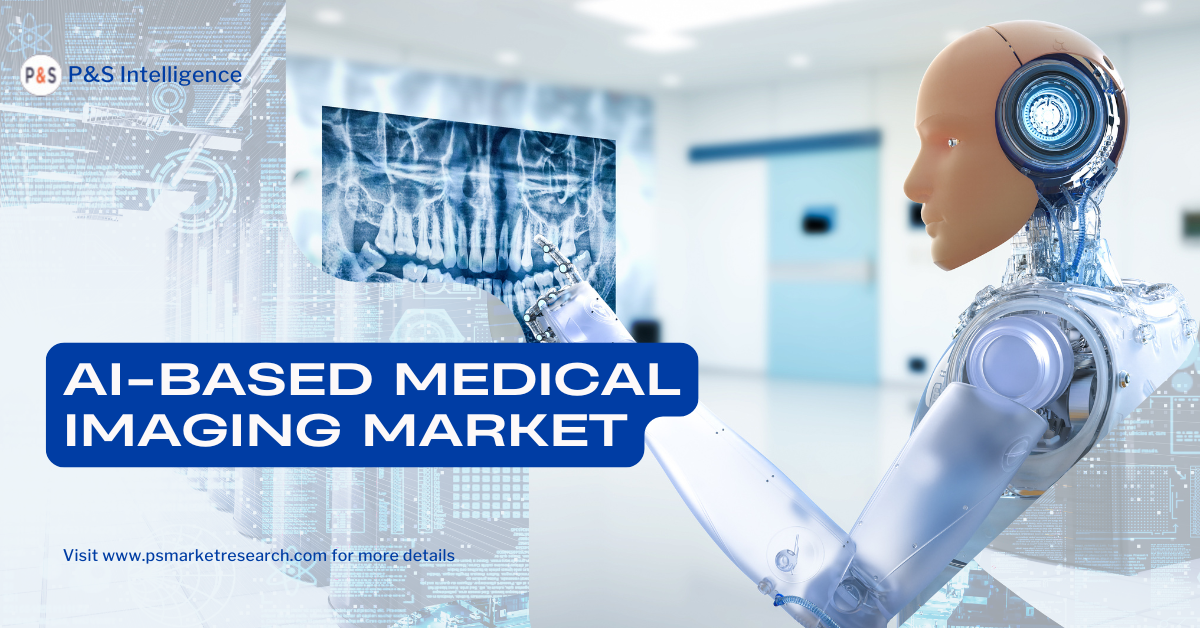
Transforming Healthcare with AI-Powered Medical Imaging

AI-based medical imaging is transforming the field of healthcare by assisting physicians in providing more efficient, personalized, and accurate diagnosis and treatment selections.

Thanks to deep learning algorithms, medical imaging equipment now allows doctors to find irregularities and discover disorders with a greater level of speed and accuracy than ever before. This is because of the substantial advancement in diagnosis precision, treatment effectiveness, and the general quality of patient care.

Over the past few years, there has been a rising acceptance of AI in the healthcare sector to enhance diagnostics, patient care, and evaluation of the patient’s medical information. The utilization of AI technology is becoming more prevalent in medical imaging. Artificial Intelligence’s goal is not to substitute radiologists but to assist them in improving the diagnostic procedure.

To learn more about this report: https://bit.ly/3XZZAfU


Understanding Medical Imaging

Simply, medical imaging refers to different technologies that are employed to observe the human body to diagnose, treat, or monitor medical conditions. It generally encompasses non-invasive picturing methods for medical personnel to recognize injuries and diagnose illnesses or chronic conditions.

The use of AI analysis in medical imaging assists doctors in identifying problem details or areas that might be missed by the human eye. For example, AI-based medical imaging can examine data points in a medical report to recognize a disease from a healthy part as well as signals from noise.

AI-powered medical imaging has been extensively utilized to:

  • Recognize complicated patterns in imaging data.
  • Identify image modalities at different treatment phases.
  • Deliver a quantitative assessment of radiographic traits.
  • Find different ailments characteristics that are not noticeable by human eyes.

Major applications of AI-based medical imaging are:

Cardiovascular Disorders

Cardiovascular disorders are generally diagnosed by assessing the patient’s heart structure. Conventionally, chest X-rays are employed first to find possible heart-associated irregularities. For instance, this technique is employed as a screening tool for an enlarged heart or cardiomegaly.

AI-powered medical imaging equipment can assist in identifying left atrial enlargement, therefore classifying a cardiac issue.

Neurological Abnormalities


AI technology has been effective in obtaining appropriate data from brain pictures. This has assisted in diagnosing different brain abnormalities.

AI-based medical imaging is also utilized to effectively diagnose neurological conditions such as amyotrophic lateral sclerosis, or ALS, and assist doctors in planning for lasting care. In addition, artificial intelligence algorithms in medical imaging can ease amyotrophic lateral sclerosis diagnosis by identifying any pictures that demonstrate suspect results.

Cancer Screening

Medical images are extensively utilized in the assessment of cancers such as colon cancer and breast cancer. For example, in breast cancer, tissue microcalcification is hard to classify as either benign or malignant. In this instance, false positives often result in unnecessary treatment, while unnoticed malignancies can delay diagnoses and affect the medical result.

AI-based medical imaging can enhance the precision and accuracy of finding microcalcifications by utilizing quantitative imaging.

In Ending This

With the surging chronic disorders incidence and the rising need for medical services for the elderly populace, the demand for AI-based medical imaging will reach USD 11,921.4 million in 2030.

Share:

Mobile Medical Imaging Services Industry Will Reach 24,344 Million By 2030

In 2022, the mobile medical imaging services market was worth around USD 14,321.5 million, and it is projected to advance at a 6.9% CAGR from 2022 to 2030, hitting 24,344.0 million in 2030, according to P&S Intelligence. This can be credited to the mounting frequency of chronic diseases and the growing quantity of diagnostic imaging centers.

To learn more about this report: https://bit.ly/3BU9Pbk

In 2022, the mobile X-ray category generated the highest revenue share, approximately 30%, mainly because of several supportive initiatives, rising expenditure, and guidelines of government bodies to advance radiography services. 

The advantages of digital X-ray systems, including quick processing, speed and accuracy, and considerably greater patient screening volumes, have supported their acceptance. This has forced companies to focus more on product growth and innovation. With quality diagnostic images, such systems allow radiologists to address an extensive variety of health conditions.

In the coming few years, the MRI category is projected to witness the highest CAGR, of above 7%, armed by the increasing incidence of multiple sclerosis and brain wounds. 

The acceptance of numerous enhanced technologies, including superconducting magnets, visualization software, and open MRI, in diagnostic centers, is fuelling the growth of the category.

By the end of the decade, the adult patient category is projected to hold the largest share, of approximately 60%, and the category is also set to show the highest CAGR, of approximately 8%, in the coming few years.

This can be credited to the growing occurrence of chronic illnesses, including cancer, CVDs, GI, endocrinal, and neurological syndromes, in adults. Chronic illnesses are long-term health situations that mainly distress aged people and, commonly, have no cure.

In 2022, the home healthcare category held a considerable revenue share, of approximately 30%, the category is also expected to experience the highest CAGR, of approximately 7%, in the coming few years.

In 2022, North America led the mobile medical imaging services market, with a worth of approximately USD 6.5 billion. This can be credited to the existence of a huge number of key players in the U.S. the region has a higher rate of acceptance of mobile medical imaging services in comparison to any other region.

Hence, the mounting frequency of chronic diseases and the growing quantity of diagnostic imaging centers will drive the mobile medical imaging services industry. 

Share:

Spinal X-Ray and CT Industry To Observe Fastest Growth In Spinal Tumor Category

The spinal X-ray and CT market will advance at a rate of 6.4%, to generate USD 1,602 million, by 2030 as said in a report by P&S Intelligence. 

Get the sample pages of this report: https://bit.ly/3ZXTawZ

This growth is credited to the increasing elderly population, the development of artificial intelligence in medical imaging, advancements in radiological technologies, and the rising prevalence of spinal injuries.

The spinal tumor category will witness the fastest growth in the industry over this decade, at a CAGR of over 7%. This is due to the growing incidence of spinal cancer all across the globe, which is boosting the demand for effective and quick treatment and diagnosis. 

In the past few years, the adult population dominated the industry, since the elderly populace has a lower density of bone, which causes osteoporosis and vertebral compression fracture.

North America led the industry, with a share of more than 40%, in the past few years, owing to the availability of numerous CT and X-ray devices, increasing investment in research and development, and developments in healthcare technologies.  

Moreover, APAC is the fastest-growing region in the industry, due to the significant developments in radiological technology, as well as improvements in the healthcare system in the region. 

It is because of the increasing prevalence of spinal injuries, development in radiological technologies, and increasing elderly population, the demand for spinal X-rays and CT will continue to grow in the coming years

Share:

How Does Medical Image Analysis Software Help in Providing Personalized Care?

The medical image analysis software industry has garnered $3,112.7 million revenue in 2021, and it is projected to generate $6,388.9 million revenue in 2030, advancing at a rate of 8.3% in the coming years. It is attributed to the surging population and increasing incidences of chronic diseases, with wide usage of computer-aided diagnosis.

To learn more about this report: https://bit.ly/3lyPqDs

In addition, the rising demand for diagnostic imaging in oncology, urology, orthopedics, neurology, and cardiology propels the industry's growth.

Healthcare technologies such as radiography, MRI, nuclear imaging, and ultrasonography are utilized for the diagnosis of chronic disorders or non-communicable diseases, as they produce pictures of the inside organs of the body. The surging requirement for modern software and enhanced imaging technologies is projected to boost industry growth.

North America leads the healthcare R&D, with a rising number of healthcare and diagnostic centers in the region. It captures the largest industry share, globally. In addition, the industry players are focusing on introducing new products that aid effective diagnosis and image-guided surgeries.

The U.S. has a higher demand for computer programs to facilitate better medical image analysis, led by the massive investments from private and government sectors, rising penetration of healthcare facilities, and increasing frequency of chronic diseases, including CVDs, and cancer.

Moreover, the European medical imaging analysis industry is projected to rise at a fast pace. It is ascribed to the rising adoption of telemedicine, increasing healthcare expenditure, technological advancements, rising awareness of the early diagnosis of diseases, and penetration of established players.

The major players operating in the industry are:

1- Siemens Healthineers

2- Canon Inc.

3- AQUILAB SAS

4- Xinapse Systems Ltd.

5- Agfa Gevaert N.V.

6- INFINITT Healthcare Co. Ltd.

7- Agfa Gevaert N.V.

Therefore, rising incidences of CVDs propel the demand for medical imaging analysis software for effective diagnosis.

Share:

Follow Me

Powered by APSense.com

Follow Me

Follow on LinkedIn

Followers

Total Pageviews

Popular Posts

Recent Posts

Label Cloud