Global Industry News
Showing posts with label Diagnostic Catheters. Show all posts

All You Need to Know About Medical Disposables

Medical disposables are an important aspect of healthcare and are utilized in various applications, such as injection administration, patient care, and wound care. Medical disposables are generally produced of materials including paper, textiles, and plastic and are intended to be easily disposable or utilized.

Medical disposables are produced to be utilized once only or temporarily. Medical disposables are quite easy to use and do not need sterilization and maintenance. Healthcare providers utilize a new device each time and dispose of it after utilization. A clinical establishment needs certain important disposables to achieve quality patient care.

Some examples of medical disposables comprise glucose monitoring strips, diagnostic catheters, radiology consumables, smart syringes, prefilled syringes, hypodermic products, nonwoven medical supplies, surgical nonwoven products, infection management products, and negative pressure wound therapy devices. These products are utilized to protect patients and doctors from contamination and to assist in avoiding the spread of illnesses.

Moreover, among these examples, nonwoven medical supplies which include bandages, surgical drapes, cast paddings & covers, dressings, swabs, and surgical gowns are the most utilized medical disposables across the globe. 
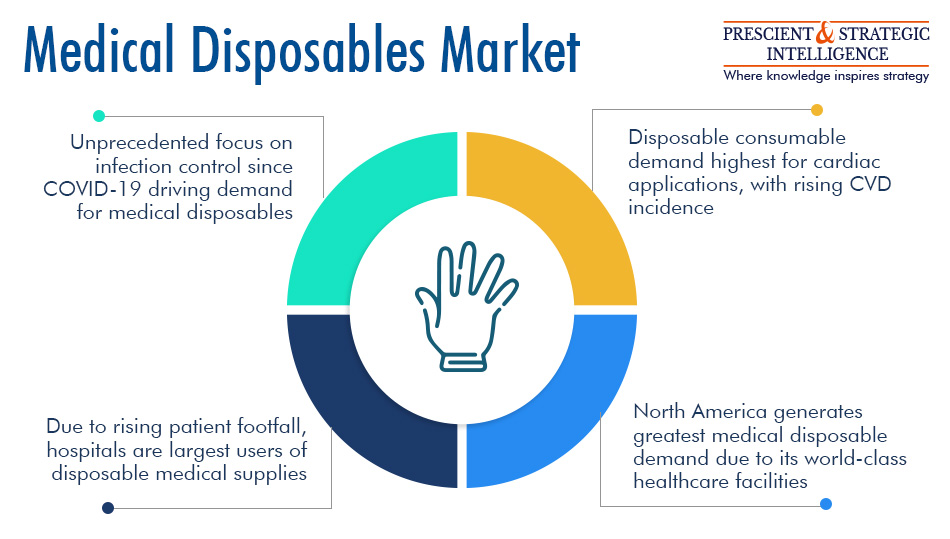
Importance of Medical Disposables

Infection Prevention

Studies were performed to inspect the existence of microorganisms on reusable and disposable medical products. Over 30% of the wet swabs taken from reusable medical goods were found to be present pathogens whereas most wet swabs taken from the disposable medical goods were found germ-free. 

Moreover, as per the CDC, the utilization of disposable medical goods enhances the safety of patients by removing the danger of patient-to-patient infection.

Save Expenses

Medical disposables may seem like a costly option to most healthcare providers; however, in the long term, single-use goods are more economical. This can be attributed to the fact that reusable medical products are costly which further rises because of the requirement of buying extra accessories. Moreover, reusable products need consistent maintenance and cleaning. An additional price is added for their consistent cleansing.

Whereas, single-use medical goods are much more inexpensive, necessitate the slightest maintenance, and do not need high processes of sterilization. Moreover, there are no extra expenses related to the repair. In contrast, these products are able to offer the same quality as those reusable medical goods.

Better Environmental Impact 

Disposable medical products may seem to have additional harmful impacts on the environment; however, if they are properly disposed of, single-use medical products are eco-friendly. Whereas, the air pollutants and chemical waste generated from manufacturing reusable medical products are much more damaging to the environment.

Time-Saving

The reusable medical devices require to be sterilized and cleaned every time it is utilized. Whereas, single-use medical devices are typically ready to utilize and can be thrown out after use. This results in time savings for the healthcare providers and enhances their productivity.

With the surging elderly population, mounting prevalence of hospital-acquired infections, and increasing incidence of chronic illnesses, the need for medical disposables will continue to surge, reaching a value of approximately 90 billion by the end of this decade.

Share:

Technological Development Will Drive Electrophysiology Industry

The incidence of cardiac arrhythmias has become so high that new technologies must be included in the production of electrophysiological devices. The widespread use of minimally invasive electrophysiology therapy has been made possible by requiring highly precise and regulated cardiac diagnostic and ablation methods.

Additionally, interventionalists are now using disposable catheters for intermittent cardiac procedures since they are more sterile, safe, and affordable.

With the arrival of cutting-edge electrophysiological technologies, an increase in cardiac ablation treatments, and supportive payment policies, the need for electrophysiology is anticipated to grow steadily.

Thus, the global electrophysiology industry will reach $17,482.7 million by 2030. This can be attributed to technological developments, growth in the demand for diagnostic and ablation catheters, and increase in the prevalence of atrial fibrillation in older people.

A major cause of mortality, according to the World Health Organization (WHO), is cardiac problems, which are grave health issues. The therapy of cardiac arrhythmias involves using several interventional techniques and implanted cardiac devices.

Get the sample pages of this report: https://bit.ly/3S1XVmS

Highest Revenue Was Generated by Sale of Ablation Catheters

The category of ablation catheters now has the biggest share. With the help of catheters, damaged electrical circuits in the heart are eliminated during ablation, a minimally invasive procedure.

The device can be utilized to remove abnormal cardiac tissue that contributes to abnormal heart rhythms. The two ablation catheter methods that are most often employed are radiofrequency and cryoablation, and as technology progresses, their use is projected to increase significantly.

Technological Advances are driving Demand in Electrophysiology Devices

The burden of heart disorders has decreased due to changes in treatment methods for cardiac arrhythmias brought about by technological improvements.

The patient pool is expected to grow globally as the aging population surges. This is anticipated to fuel the electrophysiological ablation catheter market during the next few years. CVDs are the leading cause of mortality worldwide, according to the WHO.

About 32% of all fatalities worldwide occurred due to CVDs in the previous year, killing approximately 17.9 million individuals. An estimated 85% of these fatalities were attributed to heart attacks and strokes.

During the projected period, there is anticipated to be an increase in the need for electrophysiology ablation catheters due to the rise in the prevalence of cardiovascular illnesses in the geriatric population.

Cardiac and Hospitals Centers Has Largest Share

The biggest end customers of electrophysiology products are hospitals and cardiac facilities. As a result, the category now has the biggest share in the electrophysiology market.

Additionally, this is a result of an increase in the number of ablation operations performed in public and private hospitals worldwide and increased utilization of electrophysiology and Cath labs.

Hospital-based care is in great demand due to the availability of state-of-the-art facilities for disease diagnosis and treatment and competent employees. Compared to other medical facilities, hospitals do more screening and diagnostic procedures, which results in a significant share.

Additionally, due to the development of superior electrophysiological products and the demand for minimally invasive treatments, the use of electrophysiology devices in various healthcare settings is increasing.

Share:

Follow Me

Powered by APSense.com

Follow Me

Follow on LinkedIn

Followers

Total Pageviews

Popular Posts

Recent Posts

Label Cloud