Global Industry News
Showing posts with label Next Generation Sequencing. Show all posts

Forensic Innovation and DNA Databanks Power the Future of Human Identification Market Growth

The global human identification market is witnessing steady expansion, supported by the growing need for accurate identity verification across forensic, healthcare, and security applications. Valued at approximately USD 0.82 billion in 2025 and projected to reach nearly USD 0.96 billion in 2026, the market is expected to surge to around USD 2.35 billion by 2035, growing at a CAGR of 11.8% during the forecast period from 2026 to 2035.

To learn more about this report

Rising demand for forensic analysis and the increasing adoption of DNA profiling technologies in criminal investigations are key factors propelling market growth. Governments and law enforcement agencies worldwide are strengthening their forensic capabilities, investing in DNA databanks, and modernizing laboratory infrastructure to improve identification accuracy and response times. Additionally, disaster victim identification and public health surveillance continue to create strong demand for advanced identification technologies.

Technological advancements are transforming the market landscape, particularly with the rapid adoption of next-generation sequencing (NGS) and advanced DNA analysis platforms. These innovations enable higher accuracy, faster processing, and improved scalability, making them essential tools in both forensic and clinical environments. Automated workflows and digital evidence management systems are also gaining traction, enhancing operational efficiency across laboratories.

The market is further supported by global initiatives aimed at improving forensic standards and genomic surveillance. Regulatory bodies and international organizations are promoting standardized laboratory practices and cross-border data collaboration, creating a favorable environment for sustained market expansion.

However, the industry faces challenges related to data privacy regulations, ethical considerations, and complexities in genetic data sharing. Compliance with strict regulatory frameworks increases operational costs and may limit adoption in certain regions.

Despite these challenges, emerging economies present significant growth opportunities. Increasing urbanization, rising crime rates, and the need for scalable and cost-effective identification systems are driving demand across Asia Pacific, Latin America, and the Middle East & Africa. Government-backed initiatives to develop forensic infrastructure and digital identity systems are expected to further accelerate adoption.

From a segmentation perspective, consumables dominated the market in 2025, accounting for 58% of total revenue due to their recurring demand in forensic testing processes. Meanwhile, instruments are expected to register the fastest growth, driven by advancements in automation and sequencing technologies. PCR-based technologies held the largest share among technologies, while next-generation sequencing is anticipated to grow at the highest rate over the forecast period.

Forensic applications continue to lead the market, contributing over half of total revenue, while paternity and kinship testing are emerging as high-growth segments. Forensic laboratories remain the largest end users, supported by increasing case volumes and expanding national DNA databases, while hospitals and research institutions are rapidly adopting genetic identification technologies for clinical and research purposes.

Regionally, North America leads the market with a 34% share, driven by advanced forensic infrastructure and strong government support. Europe follows with robust regulatory frameworks and collaborative forensic networks, while Asia Pacific is emerging as a key growth region due to expanding forensic capabilities and increasing investments in genomic technologies.

The competitive landscape is characterized by the presence of leading global players focusing on innovation, strategic partnerships, and expansion of genomic and molecular diagnostic capabilities. Companies such as Illumina Inc., QIAGEN N.V., Roche Diagnostics, Thermo Fisher Scientific, and Merck KGaA are actively advancing their portfolios to meet growing global demand.

Recent developments highlight strong industry momentum, with companies introducing advanced sequencing platforms, expanding digital PCR technologies, and enhancing integrated diagnostic solutions. These innovations are expected to further strengthen the role of human identification technologies in forensic science, healthcare, and national security.
As global demand for accurate and reliable identification continues to rise, the human identification market is poised for sustained growth, driven by technological innovation, regulatory support, and expanding applications across multiple sectors.
Share:

How is Next Generation Sequencing (NGS) Technology Applied in Gynecological Cancer Diagnostics?

The field of next-generation gynecological cancer diagnostics is experiencing continuous growth due to various factors such as the rising incidence of diabetes, increasing prevalence of gynecological malignancies, obesity in women, lifestyle changes, and menopause problems.

Advancements in sequencing technologies have empowered researchers and clinicians to gain insights into underlying mutations associated with gynecological cancers, leading to the discovery of biomarkers that guide targeted therapeutic decisions.

These diagnostic tests also enable early detection of cancers and other diseases, as well as accurate prognosis, which contributes to the future growth of the next-generation gynecological cancer diagnostics sector.

Uterine, cervical, and ovarian cancers are the most common gynecological cancer types in females globally. These cancers result from acquired and inherited mutations, epigenetic factors, genomic aberrations, transcriptional aberrations, or a combination of these factors. A comprehensive understanding of genomics, molecular substructure, and gynecologic cancers is essential to develop effective biomarkers for detection, prevention, molecular profiling, and personalized treatment strategies.

Next-generation gynecological cancer diagnostics play an important role in controlling, preventing, and investigating cancerous diseases.

Uses Case of Next-Generation Gynecological Cancer Diagnostics

Next-generation gynecological cancer diagnostics are used for the detection of various cancers, including ovarian, uterine, vulvar, cervical, and vaginal cancer.

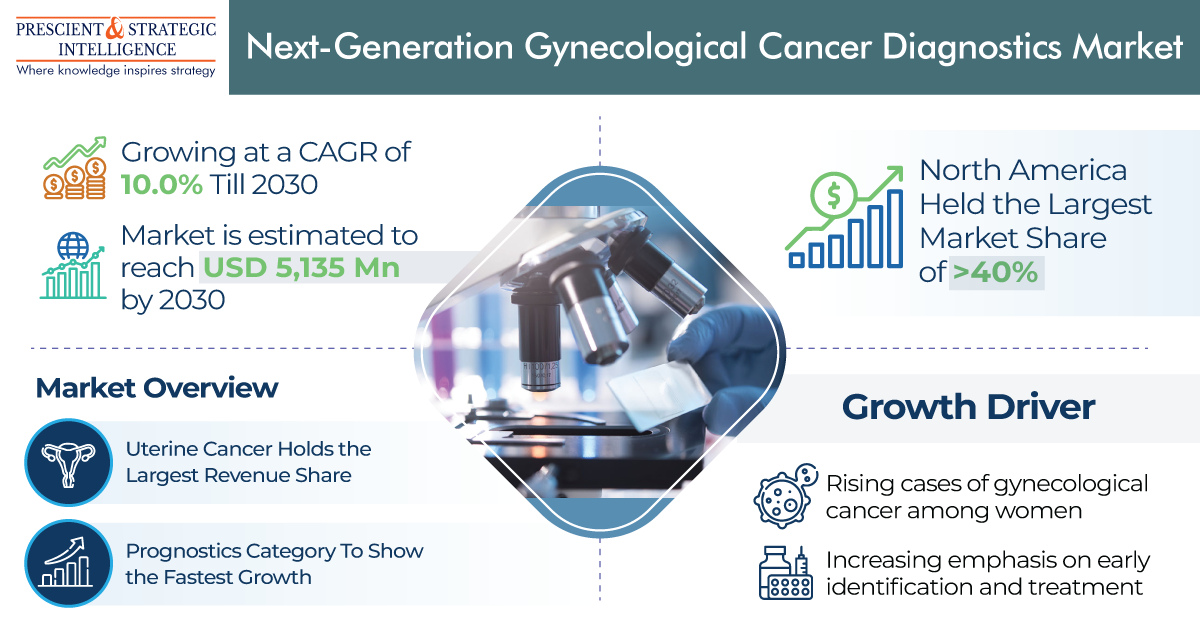
Among these, the utilization of these diagnostics for uterine cancer is particularly high and continuously increasing. This is due to the rising global incidence of uterine cancer, driven by factors such as increased menopause issues after age 55, higher prevalence of high blood sugar levels and blood pressure, the aging female population, rising rates of obesity and overweight, and elevated estrogen levels.

Furthermore, the utilization of these diagnostics for cervical cancer is expected to increase in the future, considering the growing prevalence of cervical malignancies in women worldwide.

Application of Next-Generation Sequencing (NGS) Technology

Next-generation gynecological cancer diagnostics employ technologies such as polymerase chain reaction (PCR), next-generation sequencing (NGS), and DNA microarrays.

NGS technology is particularly prominent in this field, as it can identify actionable genetic alterations that can be targeted with therapy. NGS demonstrates a 33.4% chance of identifying gynecologic cancers and exhibits a high clinical action rate. The clinical utility of NGS has also been shown to improve survival in individuals who receive targeted treatment.

Additionally, NGS plays an important role in tumor analysis and has greatly facilitated the molecular profiling of solid tumors.

DNA microarrays technology is also increasingly utilized in this context. These microarrays provide a powerful and advanced approach to studying the molecular basis of relationships on a scale that conventional methods cannot achieve.

Furthermore, they enable the simultaneous assessment of the expression of thousands of genes, leading to the development of rationale approaches for therapy, as well as advancements in gynecological cancer diagnosis and prognosis. As a result, DNA microarrays find wide application in hospitals and diagnostic laboratories.

Hence, with the advancements of technology in healthcare, developing infrastructure of healthcare, implementing advanced and rapid diagnosis of diseases, and mounting investment by both domestic and foreign businesses across Asian countries, the demand for next-generation gynecological cancer diagnostics will continue to increase, and it will reach a value of USD 5,135 million by the end of this decade.

Share:

Follow Me

Powered by APSense.com

Follow Me

Follow on LinkedIn

Followers

Total Pageviews

Popular Posts

Recent Posts

Label Cloud