Global Industry News
Showing posts with label Pneumatic. Show all posts

Sharp Revenue Jump Predicted in Global Exoskeleton Industry Between 2023 and 2030

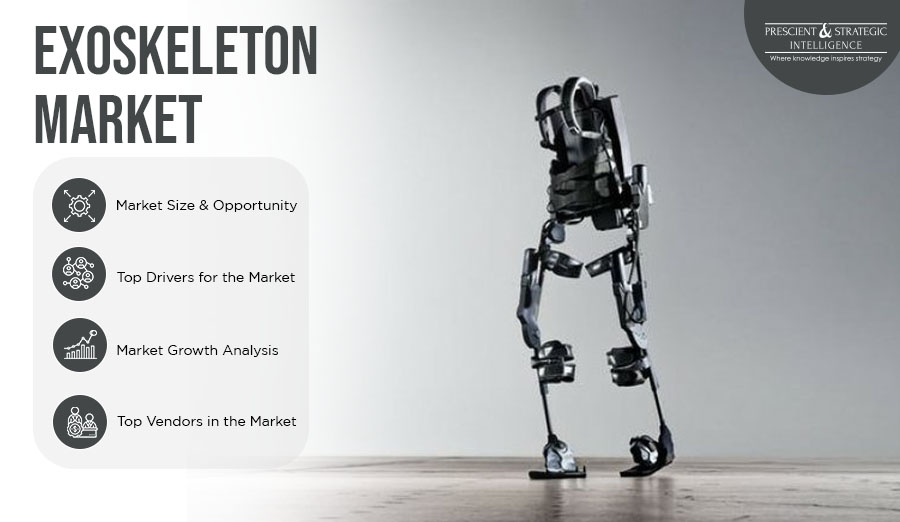
The exoskeleton market is experiencing growth and is projected to reach USD 6,957.9 million by 2030. This growth can be credited to the rising count of spinal cord injuries and strokes, growing healthcare investments, rising elderly populace, thriving job opportunities for disabled individuals, and growing penetration of such items in military and industrial operations.
Get the sample pages of this report: https://bit.ly/3WXVGDJ

The industry, under the component segment, is divided into software and hardware. Of these, the hardware category held the larger revenue share in recent years because exoskeletons mainly include hardware components, such as actuators, sensors, and powered systems. Passive exoskeletons are majorly constructed with hardware parts.

The categories under the type segment of the exoskeleton industry comprise passive and powered. Of these, the powered category is projected to experience faster development in the coming few years.

Asia-Pacific is projected to showcase the fastest development in the industry for exoskeletons in the coming few years. This will be because of the rise in the elderly populace and the growth in the utilization of exoskeletons in the medicinal field.

The quickly increasing aged pool has caused the snowballing occurrence of disability and orthopedic illnesses in the region. The elderly also results in a dropping in bone density and breakable bones, which drives the need for such medicinal items.

Key companies in the exoskeleton market are concentrating on integrating progressive technologies, like cloud connectivity, robotics, and artificial intelligence, to advance the performance of their items. artificial intelligence fuels the human potential, and also productivity, of the devices.

Hence, the rising count of spinal cord injuries and strokes, growing healthcare investments, rising elderly populace, thriving job opportunities for disabled individuals, and growing penetration of such items in military and industrial operations are the major factors contributing to the growth of the exoskeleton market.

Share:

Why Nebulizers Come in Handy in Asthama?

Grieved from Asthma? Can’t take a breath in? Inhaler fading to dismiss breathlessness? It is at these times that the Nebulizer will come in handy.

Nebulizers direct medicines where they’re required most, directly to your lungs, in less than 5 minutes. Instead, oral medications taken for asthma go through your digestive tract, then into your bloodstream to reach the lungs in at least 30 minutes to relieve you from the breathlessness. Nebulizers act just like an immediate meal in the lungs, hungry for oxygen!

Get the sample pages of this report: https://bit.ly/3ot2UlQ

Who can Use Nebulizer?

A nebulizer is a treatment to deliver medication for people suffering from asthma who can’t use inhalers like infants, young children, the old, or people who are so panting that they can’t take a breath deeply with inhalers. Medications given through a nebulizer are useful in acute conditions and can avert respirational complaints before taking serious implications. Apart from asthma, what more does a nebulizer treat?

Nebulizing is the most competent way to transport medicines to the lungs. Therefore, they are seamless for respiratory issues such as sinusitis, asthma, emphysema, allergies, bronchitis, flu, cystic fibrosis, chronic obstructive pulmonary ailment, and more. This technique of supplying medications through a nebulizer also dissolves substances that might be obstructing the airways.

How does a Nebulizer work?

A nebulizer is an electric vaporizer, and it gives out the medicine as a spray of particles. It is a relatively small air compressor converting medications into an air mist that can easily be breathed in through a mouthpiece, or a mask.

For hefty doses of inhaled medicine, a nebulizer is remarkably convenient. For both instant relief and upkeep of asthma symptoms, medications are obtainable for usage with a nebulizer.

But during an emergency, what is better? Here is a comprehensive look at nebulizers as well as inhalers. It is pretty easy to use a nebulizer. You have to do nothing other than sit in one place and breathe through the facemask, or mouthpiece while the usage of an inhaler requires learning the preliminary procedure and some amount of practice.

A nebulizer guarantees that the complete dosage reaches the lungs straight. Alternatively, with an inhaler, the medicine every now and then will reach only the throat and not get down lower beyond that, suspending immediate results and not providing the amount of relief that is likely with a similar dosage of the medicine.

Why there is a need for a Nebulizer?

There is no denying the fact that, almost every person is breathing polluted air, which is a major cause of asthma, and many other respiratory diseases. When there is an increasing number of respiratory issues, then the use of nebulizers will be quite common.  The use of nebulizers increased rapidly during the time of the pandemic, as there were a lot of people, who were feeling short of breath.

Because of this, the nebulizer market will reach approximately 1,698 million by the year 2030.

Share:

Follow Me

Powered by APSense.com

Follow Me

Follow on LinkedIn

Followers

Total Pageviews

Popular Posts

Recent Posts

Label Cloud